Three hours a day on social media, over a lifetime, adds up to 13.4 years of your conscious life.
Scary, isn’t it? This was the number that stopped me dead in my tracks. Although I’d like to claim superiority, it still took me a further 48 hours to convince myself to delete social media. Months later, in Bukhara, the number had turned into four lines in my notes; Time flies. You don’t have long. And you can only rely on yourself. Be your own best friend. I didn’t expect four lines to have the impact they’ve had, and they’re the reason I picked this post back up. Each line turned into a question I ended up chasing, so what follows is really an explanation of that one note, part by part, and by the end I hope you’ll see why it stuck.
Before we go any further, I’d like to be honest about what this is. I’m not a psychologist, and I’m definitely not a monk. I’m someone who deleted Instagram and replaced it with an AI chatbot. This isn’t going to be the most accurate piece of content you’ll read on attention. It’s me trying to work out why I reached for my phone so often, and what I’m meant to do with the time I get back. I sometimes think I’m overthinking it, and that I’m creating a fabrication of lies when I’m writing, so take it as one person working it out as they go.
The more I’ve thought about this blog, the more I notice the same habit in other people; how quickly they become anxious, and how quickly they reach for their phone as a distraction. We hold onto it like a barrier to the real world, and talking to people, actually interacting with the real world, has become the secondary state. I’ve been on the wrong side of that barrier more times than I’d like to admit.
Most of this was written on the road, in Central Asia and now the mountains of Georgia, where every night before bed I’ve been giving the day a score out of 5. That small habit has ended up shaping a lot of what you’re about to read. The post itself, though, started back in March, and I never finished it. In my notes from Bukhara this month, I was honest with myself about why; I never finished my first post, because I got addicted to my phone again, mainly just using AI all day.
Which makes this next part a little awkward, because I used AI, Claude specifically, to help me finish it. I can formulate my thoughts into words best when I speak to someone, it’s like putting the jigsaw together, so I talked a lot of this through with it. The core ideas and the experiences are mine. I’m not the best writer, though, and mainly used this as an exercise to get back into writing. Claude found most of the studies I lean on, and turned my initial draft and notes into a nice piece of writing. Given this entire piece is about not handing your thinking over to a machine, it felt wrong not to tell you.
Where I’ve landed, for now, is this; the feed has taken over a job that used to belong to us, deciding what’s important. It fills every gap in our day, it takes away the practice of sitting with our own thoughts, and it’s owned by individuals whose interests are not our own. The only way I can see to take that job back is to disconnect, even if it’s only for two minutes at a time. As it turns out, most of what I’ve worked out was worked out by someone smarter a long time ago, in some cases a few hundred years ago. In the same notes from Bukhara, I wrote that it’s all half known, because you hear these things but don’t digest them until you come to the realisation on your own, and that’s how this post works. I’ll tell you what I came to on my own, then point out who got there first.
From Khiva to TikTok.
To understand how the feed got that job in the first place, it’s worth going back to where the algorithm started. Algorithms as a concept are not new; they date back to Al-Khwarizmi, a mathematician working in the 9th century. His name is where the word ‘algorithm’ comes from, and his step-by-step methods for solving equations gave us algebra, which is still taught in the later years of high school across the globe. My Free Walking Tour guide in Khiva, Uzbekistan, in the region Al-Khwarizmi takes his name from, had a joke ready for exactly this; “don’t blame Uzbekistan for what AI is doing”.
Nowadays, the word means something very different; a hyper-personalised, engagement-optimised, real time recommendation feed, as exemplified by TikTok, Instagram or any platform that is serving advertisements.
In my lifetime, the internet has gone from a generally free and helpful place to one where it’s difficult to have an online interaction without an algorithm subconsciously shaping your experience. We can blame commercial exploitation for that. Algorithms in the modern world are not a product of scientific inquiry, but the result of billions of dollars invested into understanding how to maximise engagement, and therefore advertising revenue.
Unfortunately, the algorithm is now the crux of our day-to-day lives. It can be argued that it has its positives; it may lead you to discover new music, guide you on methods to improve your diet or physical health, or simply give you a feeling of inclusion as you come across new memes to discuss with your friends. I pointed to these benefits myself, long before I’d admit I was addicted. However, helping you was never the objective. The objective is to keep you engaged, to feed you more advertisements, and potentially to shift your thoughts on controversial topics subconsciously. Even when it is helping, the circuit is continuously open, there is no end to the curated content you’re experiencing, and that is slowly reducing our natural curiosity.
None of this is an accident. The question we need to ask ourselves when we pick up our phone is; why does Instagram hire psychologists? And why would over 50 renowned psychologists in 2018 send a letter to the American Psychological Association, asking it to take an ethical stand against the damage caused by the “persuasive design” these companies use? In short, the issue is simple; if you open your phone to reply to a message, the chances you’ll end up opening another app, viewing suggested content, and scrolling once, twice, endless times, are a lot higher than we care to admit. Persuasive design makes us forget the reason we picked up our phone in the first place. Our intentions may have been fantastic, but we’ve thrown ourselves into the rabbit hole with no idea where we will end up.
The cost goes well beyond lost time. According to the CDC, 50% of teenagers are spending more than 4 hours a day on their devices. These results may shock you. However, the consequences extend to our physical and mental health; teens with excessive screen time are significantly less likely to be well-rested, keep a consistent sleep schedule or get adequate physical exercise, and most importantly, they are more than twice as likely to have symptoms of depression or anxiety.
This is what I meant earlier by the feed taking over a job that used to belong to us. The default state of our unstructured time has shifted from self-directed to algorithmically directed, and it is indeed the capitalistic environment that has led us away from exploring our natural curiosity. That’s where the name of this blog comes from. ‘Analog Attention’ is about reinforcing the importance of your natural curiosity, and using your own spirit of inquiry to shape your day-to-day.
The ultimate goal of these journals is to restore our analog attention and rediscover our natural curiosity. In short, we’re going to be focusing on letting our mind wander. Sometimes all you need to achieve this is a little bit of old-fashioned peace and quiet, and Sherry Turkle puts it better than I can;
“When we let our minds wander, we set our brains free. Our brains are most productive when there is no demand that they be reactive.” - Reclaiming Conversation, Sherry Turkle
The Genie in our Pocket.
The same book gave us a term that I think is a fantastic analogy for why the majority of individuals spend 7 hours a day on devices; the Genie in our Pocket.
“Cell phones make us promises that are like gifts from a benevolent genie… that we are never to be alone, that we will never be bored, that we can put our attention wherever we want it to be” - Sherry Turkle.
Personally, I didn’t think the genie had much of a hold on me. I didn’t think of myself as addicted to social media; it was simply a mechanism to unwind. I had accounts, I checked them, I mainly browsed Reddit to read about topics I’m interested in, and scrolled reels as a ‘low brain power’ activity.
Except, the issue is the habit had become invisible, woven into every gap between every task; the two minutes while waiting for my coffee machine to heat up in the morning, while waiting for others to join a meeting, while the ads played on YouTube.
Add those gaps up across a day, and the result is the collapse of unstructured time. People have always looked for ways to escape boredom, as we’ll get to, but until recently the escape wasn’t sitting in your pocket, so most of the time boredom got to do its job. When you’re bored, the parts of your brain known as the ‘default mode network’ get to work; processing, consolidating, creating, learning and most importantly building a coherent version of self. That unstructured time allows your brain to complete some of its most important work.
However, we’ve tricked ourselves into believing that boredom is unproductive, and in a capitalist world, you’re not reaching your full potential if you find yourself bored. The genie in your pocket understands that the easiest way to solve boredom is to open up a world of opportunity in your hand, and that opportunity, however unproductive, is disguised as productive through a mask of social interaction.
I’m as guilty of this as anyone, and not only with my phone. When I asked myself on this trip why I spend so much of my time planning, this is what I wrote;
Planning is to me this trick of efficiency and productivity in a capitalist environment. You always need to believe that you are being productive, and I scratch the itch when I’m planning or preparing something. It’s different from simply watching a movie, and it feels productive.
This is how the algorithm works, it will feed me travel content and hiking gear recommendations while traveling. Therefore, I believe I am being productive by learning about what my itinerary can be, and what to buy for these activities, and I’ll avoid the scary possibility of being bored!
This is the trap.
There was never a moment of silence. The phone became an escape so natural that no one questioned it, and our default idle activity changed without us realising. If you’re stuck in an awkward group conversation, hoping someone crossing the street doesn’t spark a conversation with you, or you’re just after a low brain power activity, the get out of jail free card is to open up your phone. That’s at the best of times. At the worst of times, the phone is a device that is used to sway elections and opinions, the evil we do not care to admit.
As we know, misinformation is running rampant online. How many times has someone you know referenced content that later turned out to be incorrect? Yet we still put our trust in these devices to fill our unstructured cognitive space.
The Spectrum of Content.
Not everything we fill that space with is equally bad, though. We engage with content by default, and there are many ways to do it, which is why I’d like to introduce a term; The Spectrum of Content. It’s a simple way to picture how involved your own mind is in whatever you’re engaging with. Imagine the X-Axis (horizontal) as a scale of how reactive the content is, and the Y-Axis (vertical) as the degree of cognitive autonomy, from self-directed to algorithmically directed.
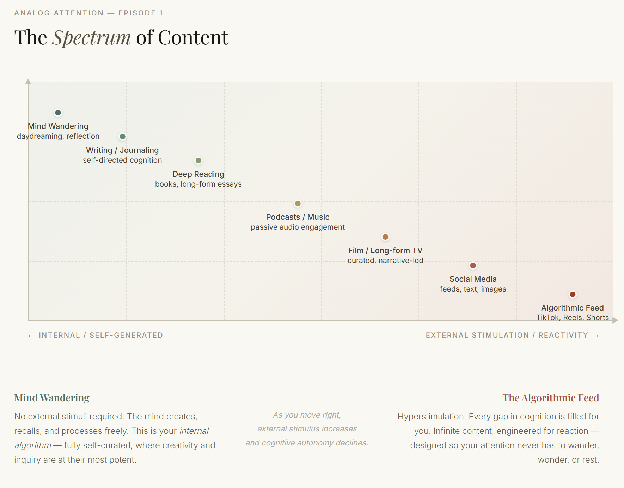
On the far left of the spectrum is an experience that happens entirely internally; to put it simply, we’ll call this mind-wandering. At this end, your mind can create, process, recall and relive without any external stimuli, using your cognition to the fullest, and it’s when our minds are at their most productive, with no requirement to react to anything external.
This end can be a fully curated environment too, which is what I call your internal algorithm. It’s a self-curated recommendation engine, built from your own memories and desires, and it’s where your creativity shines. As a result, it’s also where you experience the spirit of inquiry, and that spirit declines the further right we move along The Spectrum of Content.
On the far right, we have the hyper-personalised algorithmic feed, such as TikTok. It’s an experience that can only be classed as hyperstimulation; short form content that often follows a trend or a narrative, and a way of feeling social connection with billions of people around the globe, or simply within your friendship group.
Here, your mind is constantly reacting. You tend to ignore stimuli that exist outside of your device, because you’re hooked into the sensations it provides. TikTok aims to absorb your cognition to the fullest; you never need to fill in any gaps, because you can simply watch the reel and read the comments, and what better way to exacerbate the cycle than by sharing it with someone you know? That removes curiosity from the loop completely, because curiosity needs a gap. Back in 1994, the psychologist George Loewenstein described curiosity as an itch, the gap between what you know and what you want to know. The feed scratches every itch before you’ve even had the chance to feel it. Compare that with what I wrote after the best hike of my life, in Kyrgyzstan; a whole mountain to ourselves scratched the itch, and reignited it. Scratch it yourself and it comes back; let the feed scratch it and it doesn’t.
As a result, we end up buying into everything we’re shown. It affects what we value, and what we spend our time and money on. This is the ultimate outcome of voluntarily handing control of our stimuli over to an algorithm controlled by a billionaire.
It would be easy to blame TikTok and move on, but the same playbook is used almost everywhere you look. Games reward you for logging in every day and punish you for missing one, loot boxes and random drops work on the same principle as the pokies, and limited-time events prey on the fear of missing out. Facebook Marketplace is a list that simply doesn’t stop, there is no bottom to reach, and the perfect deal always feels like it’s one more scroll away. Blaise Pascal, a French philosopher, noticed the same thing in hunters back in the 1600s; give a man the hare before he sets out, and he won’t want it, because it was never about the hare, it was the hunt. YouTube and Netflix will start the next video or episode before you’ve had the chance to decide, so stopping becomes the choice you have to actively make. Even pulling down to refresh your feed works like pulling the lever on a slot machine, and its inventor, Loren Brichter, has since admitted that pull-to-refresh is addictive. Then you have the streaks on Snapchat and Duolingo, and the little red notification badges, all designed to pull you back in.
Each of these has the same ingredients; there’s no natural stopping point, the rewards are unpredictable, and there’s always the fear of losing something. Together, they make sure a gap never has the chance to open, and as we know, curiosity needs a gap.
Applications are designed to get you hooked, and re-hooked. This predatory design has changed our subconscious into one that demands hyperstimulation, and through these ‘evil’ practices, they’ve achieved their goal of having billions of us reaching for it every single day. The control, however, still lies with you to shift the focus.
Are we too late?
Whether we still know how to use that control is a different question. Pascal had a second observation that I can’t get out of my head; all of humanity’s problems come from one thing, our inability to sit quietly in a room alone. He wrote that in the 1600s, without a phone in sight.
Some 350 years later, a 2014 study by Timothy Wilson and his colleagues suggested he was onto something. In it, 67% of men and 25% of women gave themselves an electric shock rather than sit alone with their thoughts for 15 minutes, and these were people who had said beforehand that they would pay to avoid that same shock. You could infer that we’re unhappy with our thoughts. However, I’d argue it’s simpler than that; we’re bored, and boredom has become so unfamiliar that a small jolt of pain is preferable to sitting in it.
What’s more concerning is what came five years later. Wilson and his colleagues ran a version of the study with 2,557 people across 11 countries, and in every single country, people enjoyed doing something, such as reading, watching TV or browsing the internet, more than being left alone with their thoughts. The individuals who enjoyed thinking the most tended to enjoy thinking for its own sake, were open to new experiences, or had meditated before, whereas the individuals who enjoyed it the least reported using their phones more. It can be argued that this doesn’t prove the phone is the cause, as it could be that people who struggle with their own thoughts simply reach for their phone more often. However, either way, the more time we hand over to the screen, the less practice we get at the one skill it’s replacing.
This opens up a can of worms; have we passed the point of no return? It is hard to imagine a world today without utilising content, and the point I’d like to place at the forefront of your mind is this; your inner workings are now being shaped by external stimuli. A month into this trip, I wrote a line in my notes that I keep coming back to; people don’t know how to be their own best friends. However, I think the more important question is why so many of us don’t want to face our own thoughts in the first place.
The sceptics have an answer to that question. In 2010, two Harvard psychologists, Matthew Killingsworth and Daniel Gilbert, checked in on thousands of people throughout their day using, ironically, an iPhone app. They found our minds wander almost half the time, and that people were less happy when it happened. Their conclusion was blunt; a wandering mind is an unhappy mind. So if letting our minds wander makes us unhappy, why would anyone want more of it?
Except, the issue is that not all mind-wandering is the same. In 2013, a team of researchers in Germany looked at what people’s minds were actually wandering to. When people drifted into the past, or into thoughts about other people, their mood tended to drop afterwards, even when the thought itself was a pleasant one. Whereas when they drifted into the future, or into thoughts about themselves, their mood tended to improve, even when the thought was a negative one. As strange as it sounds, worrying about next week’s deadline may leave you better off than reminiscing about last weekend.
That’s the difference between wandering and ruminating. Ruminating is when the mind gets stuck, replaying the argument you lost, or comparing yourself to someone else’s highlight reel, whereas wandering moves, and it mostly moves forward. It makes me wonder how much of this unhappiness comes from what we’ve been feeding our minds. If the feed spends all day serving us other people’s lives, it shouldn’t come as a surprise that when our minds finally do wander, they wander straight back to other people.
That leaves me with two questions. If we cannot spend 15 minutes a day digesting, reflecting, pondering or letting go, are we really in charge of our own mind? And will we ever be at peace, or truly happy, if we are subconsciously letting an algorithm shape our goals? I’d argue the answer to the first question is no. The answer to the second, which you might not expect, seems to be yes; plenty of individuals are perfectly happy letting an algorithm shape their goals. However, being happy and being in charge of your own mind are not the same thing.
The Pleasure Machine.
Now to be cynical of my own argument. If people struggle to sit with their own thoughts, and they’re happy with something else to think about, have we actually solved a problem? It’s somewhat the plot of everyone’s favourite movie, The Matrix, where Cypher knows the steak isn’t real, and he chooses it anyway; ignorance is bliss. The counter argument most people make is simple; if we’re happy, there is no problem. Happiness seems to measure the holistic success of humankind to a greater degree than any other statistic, and someone with a loving family, good health, a roof over their head and food in their stomach generally seems to be happy. If that person can be kept happy by TikTok and social media absorbing their thoughts, then potentially their thoughts never transition into a “more” mindset, where they’re never satisfied with what they have.
The philosopher Robert Nozick posed this exact question in 1974, long before anyone had a phone in their pocket. He asked us to imagine a machine that could give you any experience you wanted for the rest of your life, and you would never know you were plugged in. Would you plug in? Most people say no, which suggests we care about more than just how our life feels; we want to actually do things, and to be in contact with what’s real.
However, in 2010 the philosopher Felipe De Brigard flipped the question on its head. He told people they were already in the machine and asked if they wanted to unplug, and many of them chose to stay. We don’t want to plug in, but once we’re in, we don’t want to leave.
This is exactly what the feed has done. Nobody asked us if we wanted to plug in; we were handed a phone at 10 years old, and by the time we noticed, we were already inside.
There is one big difference between Nozick’s machine and ours, though. Nozick’s machine was built for you, to give you whatever experience you wanted, whereas the feed is built for someone else. It’s owned by some of the richest individuals on the planet, and it’s designed to keep you watching, not to make your life better. That “more” mindset, the one that’s never satisfied with what it has, is exactly what the ones at the top would rather we didn’t have.
Which brings me to a theory about capitalism that I’d been forming, before finding out I was about two thousand years late to it. Within a capitalist world, the ones at the top do not want to share their wealth, so they need to keep the masses from seeking that wealth and the power that comes with it. It would be a stroke of genius, then, to keep the masses’ minds occupied with stimuli, so those thoughts never get the chance to form. If they can slow down the eternal struggle for power, they have more time to accumulate it.
Around 100 AD, the Roman poet Juvenal mocked his fellow citizens for handing over their political power in exchange for two things, bread and circuses. In 1932, Aldous Huxley wrote Brave New World, where the population is kept under control, not with violence, but with pleasure and a drug called soma. In 1967, the French philosopher Guy Debord wrote that everything we once lived directly had turned into a spectacle we watch, and that the more we watch, the less we live. Then in 1985, Neil Postman argued in Amusing Ourselves to Death that Huxley, not Orwell, had predicted the future correctly, and that we would come to love the very things that stop us from thinking. Postman was worried about the evening news; imagine what he would make of a feed that never ends.
Whether it’s a deliberate plan from the ones at the top, or simply a business model chasing advertising revenue, I’d argue it doesn’t matter, because the result is the same. It might look like this contradicts what I said earlier about phones being used to sway elections, but it doesn’t; outrage is content too, and a feed full of it keeps you watching just as well as pleasure does. Either way, the masses stay occupied enough, happy or angry at whatever we’re served, and the questions we might ask about who holds the power never get the gap they need to form. Looking back at those electric shocks, it’s hard not to wonder whether that goal has already been reached.
So why disconnect, if we’re happy? The answer is simple; you can’t choose to leave a machine you don’t know you’re in. Disconnecting, even if it’s only for two minutes, is how you find out which thoughts are actually your own.
What I filled the gap with.
Disconnecting is exactly what I tried, and it didn’t play out the way I expected. Deleting social media didn’t leave me with silence, it left a gap, and I filled it with AI. I’d like to claim this was a deliberate choice, but it crept in the same way scrolling did, into the gaps between everything else. The difference was what I was doing inside those gaps; instead of being served reels, I was asking questions. One answer would lead to another question, and for the first time in years, my curiosity felt like my own again.
I’m not convinced I’ve come out ahead, though. On 20 October, in Samarkand, I wrote this in my notes;
I replaced my use of Instagram with Claude. Am I benefiting? Is it the same trick that Instagram offers you? 1 beneficial reel for 15 negatives? Unsure.
I’m still unsure. It’s very easy to dress up the reactive end of the spectrum as productivity, which is the same trap I fell into with planning.
So where does AI sit on The Spectrum of Content? On the Y-Axis it sits at the self-directed end; I bring the question, and nothing is served to me that I didn’t ask for. The X-Axis is harder to place. It’s still reactive, it answers instantly, and it will happily fill every gap I give it. If we think back to Loewenstein’s itch, the feed scratches the itch before you’ve even felt it, whereas AI only scratches an itch you’ve already felt. It’s the closest thing I’ve found to an external version of the internal algorithm.
However, there is a catch I can’t ignore. The best ideas I’ve had didn’t come from an answer, they came from sitting with the question for a while, and if every question gets answered in ten seconds, the gap that curiosity lives in never gets the chance to open. I’d assume the difference between AI being the cure and AI being the new feed is simple; whether you open it with something you’ve already wondered about, or you open it the way you used to open Instagram.
So what’s the fix?
The fix isn’t to reach Nirvana by meditating 15 hours a day, and it isn’t to throw your phone in the ocean either. It’s to take that job back from the feed, and let your internal algorithm decide what’s important.
Every feed you scroll is a recommendation engine trained on your behaviour, and the internal algorithm is no different, except it’s built from your own memories, questions and desires, and the only one curating it is you. Unfortunately, like any algorithm, it only gets better with use. If every gap in the day is handed over to TikTok, it never gets trained, so when we finally do sit with it, it feels slow and boring, and we reach for the phone again. Fortunately, we’re much worse at predicting how this will feel than we are at actually doing it. In a 2022 study, people expected that waiting alone with their thoughts would be dull, then enjoyed it more than they predicted, about as much as another group who spent the time checking the news. We aren’t bad at thinking, we’re simply out of practice.
So start small. In the two minutes while the coffee machine heats up, there’s benefit to letting your mind have free rein. It isn’t about the coffee machine, it’s about who decides what fills the gap. Maybe your internal algorithm reminds you to call Mum, to organise something, or that you should go for a run, and some days it’ll be nothing at all. This isn’t just a nice idea either; in 2011, when researchers in California checked in on what wandering minds were actually doing, most of it was focused on the future, and a lot of it was planning our own lives. The feed decides what’s important for you, whereas two minutes of quiet lets you decide for yourself.
The ritual can continue until those two minutes each day become ten. It is my belief that the longer you’re disconnected, the less you’ll want to be connected. I’ve watched the same thing happen with discomfort on this trip; this week in Mestia I wrote that two months ago hitchhiking and no booking for a hotel scared me. Now I don’t want to do it another way. There’s some evidence for it too. In 2020, researchers paid people to deactivate Facebook for four weeks, and they reported being slightly happier, spent more time with friends and family, and used Facebook less once the experiment was over.
The same spectrum applies to a whole day, not just ten minutes of it. On this trip, the scores didn’t come down to the scenery or the company. The days that scored lowest were the ones where I was a spectator. In Bukhara I wrote I think Uzbek is just too planned and catered for tourists. It doesn’t feel like people are here, before adding, in fairness, maybe I’m cynical because of my mood. The days that scored highest were the ones where I was the one choosing. I’m chasing what I find out, not doing a bucket list. Four days later, I wrote this;
Nice to just grab a beer after simply wandering around, sit down at the hostel, talk rubbish for a little bit and actually feel like I’m living and not just spectating again.
It’s almost exactly what Guy Debord meant; the more we watch, the less we live. His answer was the dérive, wandering through a city with no destination in mind and letting the streets decide where you end up. Without realising, I’d been doing my own version of it. Walking is my reset, as I put it in my notes, and back in Bukhara I wrote that I’m catching random buses to random towns and feeling completely at ease.
I even ran an accidental experiment on a trek. One day I walked without music, the next I had it on all day, and with the downhill it really made it feel like a different experience. Looking back, I can vividly remember the day without music, and the day with music is only remembered in glimpses associated with the songs I enjoyed the most. It’s The Spectrum of Content on a mountain.
None of this would have stood out if I wasn’t keeping count. When I realised this trip was teaching me more than any trip before it, I wrote that maybe it’s just because I’m more actively aware and noting the emotions and therefore keeping count. Either way, the noticing needs practice too, and scoring my days has meant actually stopping each night to ask how the day went, and why. There’s something to it; psychologists at UCLA found that simply putting a feeling into words takes some of the sting out of it, and Marcus Aurelius was doing the same thing almost two thousand years ago. His Meditations were never meant to be published, they were notes to himself.
Speaking of noticing, a personal question to the reader; have you checked for notifications, or the time, since starting this article? There are of course individuals who still read, and if you haven’t checked, I applaud you.
Which brings me back to those four lines from Bukhara; Time flies. You don’t have long. And you can only rely on yourself. Be your own best friend. When I wrote them, I thought they were about travelling solo. Reading them now, they’re the whole post. Time flies is the 13.4 years. You don’t have long is why two minutes at the coffee machine matter more than they sound. You can only rely on yourself is the internal algorithm; nobody else is going to decide what’s important for you, and the feed has already volunteered. Being your own best friend is the part I’m still working on, because it’s the one skill those electric shocks suggest we’ve lost; sitting with yourself, and enjoying the company.
What the internal algorithm actually is, what feeds it, what starves it and how you retrain it, is a bigger question than one post can answer, and that’s the objective of these journals. I don’t have the answers yet, so we will learn together, with the hope of restoring our analog attention.
Sources
- Sherry Turkle, Reclaiming Conversation (2015)
- Blaise Pascal, Pensées (1670)
- Juvenal, Satire X (around 100 AD)
- Aldous Huxley, Brave New World (1932)
- Guy Debord, Theory of the Dérive (1956) and The Society of the Spectacle (1967)
- Robert Nozick, Anarchy, State, and Utopia (1974)
- Neil Postman, Amusing Ourselves to Death (1985)
- Marcus Aurelius, Meditations (around 170 AD)
- George Loewenstein, “The Psychology of Curiosity: A Review and Reinterpretation” (1994)
- Matthew Lieberman and colleagues, “Putting Feelings into Words” (2007)
- Felipe De Brigard, “If You Like It, Does It Matter If It’s Real?” (2010)
- Matthew Killingsworth and Daniel Gilbert, “A Wandering Mind Is an Unhappy Mind” (2010)
- Benjamin Baird, Jonathan Smallwood and Jonathan Schooler, “Back to the Future: Autobiographical Planning and the Functionality of Mind-Wandering” (2011)
- Florence Ruby and colleagues, “How Self-Generated Thought Shapes Mood” (2013)
- Timothy Wilson and colleagues, “Just Think: The Challenges of the Disengaged Mind” (2014)
- Paul Lewis, “‘Our minds can be hijacked’: the tech insiders who fear a smartphone dystopia”, The Guardian (2017)
- Nicholas Buttrick and colleagues, “Cross-Cultural Consistency and Relativity in the Enjoyment of Thinking Versus Doing” (2019)
- Hunt Allcott and colleagues, “The Welfare Effects of Social Media” (2020)
- Aya Hatano and colleagues, “Thinking About Thinking: People Underestimate How Enjoyable and Engaging Just Waiting Is” (2022)